Friday, March 19, 2010

Heavy Rain and the future of Interactive Fiction


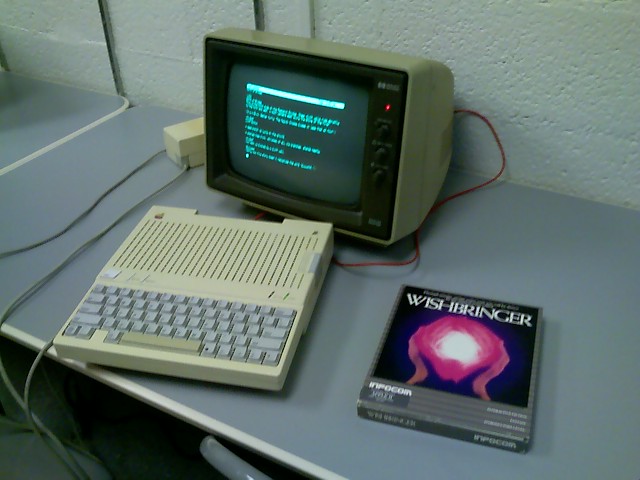
Photo by believekevin

Recently I've heard a lot of Buzz about a new console game called Heavy Rain. I've not played it personally, but I've read several reviews, I've watched the game be played, and I've done a fair amount of research on it. It's being called a new paradigm in gaming, and hailed as incredibly original. 

As I listened to all the hype that surrounded the game, I was met with something akin to Deja Vu: an intense sense of 'this-has-already-been-done-to-great-effect.'  Heavy Rain is billed as an "interactive Drama" one player I spoke with went so far as to say "It's like a movie, only you're the main character, you write the story." 


When I heard that, it clicked. These games aren't new and innovating, they are moving a time tested format (that dates back to the 1970s and Colossal Caves) known as interactive fiction from words to pictures. 

Interactive Fiction games are a small subset of the 'Text Adventure' style of games.There are hundreds upon hundreds of Text Adventure games that are not interactive fiction. These games often have a sparse setting, and a more sparse plot. They don't understand what you tell them, at all. They are frequently frustrating, and rarely fun. If your only exposure to Text Adventures was the 1980s Scott Adams style, please consider giving them another chance. 

There are, however, a large, perhaps equal, number of 'Text Adventure' games that are interactive fiction. These games are works of fiction in which the player assumes the role of the main character. He wanders through well crafted prose, marveling at the locations that the author has beautifully formed, conversing with the characters that inhabit this world of prose. The things the player says are understood, or at least mis-understood in a helpful (or amusing) way. 

If Heavy Rain is a movie, then a Text Adventure is a Novel, a Short Story (occasionally, a poem). They are rarely as easily accessible as they're screen counterparts, but they are often far more fulfilling and complex. 

As I said, Text Adventures have been written for as long as we have had computers. The first, Colossal Caves, (which became Dungen, which become Zork, which became the Zork trilogy that launched Infocom, who was acquired by Activision, who still makes good video games.) was written in the late 70s on a mainframe at MIT.

 I have a hard time calling Colossal Caves and games like it "interactive fiction."  It isn't the quality of the prose that prevents them from attaining this distinction. The prose is actually quite nice, with some highly detailed descriptions, and some incredible bits of humor. What limits these games to being 'text adventures' is that there isn't really any fiction with which one may interact. What plot is there is just an excuse to string together some puzzles, and explore a cave/dungeon. It's a fun game, but it's just a game. 

For my money, the first real work of interactive fiction was the game "The Hitchhiker's Guide to the Galaxy" published by Infocom in 1984. This is the first time that a Novelist collaborated with the programmer to create not just a game, but an entire world which a player might lose himself as the protagonist. (I know I've mentioned this game in several recent posts. But it's a good game. You should play it.) This was a story first and a game second, in much the same way as Heavy Rain. 

The Hitchhiker's guide to the Galaxy was one of many incredibly rich and plot driven works that Infocom published in it's heyday. No commercial works have been released since the late 80s (or the early 90s, depending on how far you stretch your definition of Text Adventure), but Text Adventures are not a lost art form, any more than the novel is. They are still being written, and written well. It's about as easy to pick up a text adventure game as it is to read a book, provided you're willing to take the time to do it properly. 

From the collapse of Infocom circa 1990 until very recently, text adventures haven't needed to be particularly friendly. The people who were playing them were, by and large, the same people that were producing them. This became a bit viscous cycle, as authors began to make their games less and less accessible to the novice user. Many of these are good games, but they lack the polish often found on the really stellar games and the better commercial titles. 

This all changed right around the year 2000 with a game called Photopia (click to play online.) Photopia is a non standard Text adventure. It's a game that can be enjoyed by someone who has never played a text adventure. It is not a simple game, though it is a straightforward one. You make choices that dramatically effect the outcome of the plot, but there isn't much problem solving involved. The prose is eloquent, the plot is stunning, and the game is fueled by emotion. 


As the written word goes, it falls closer to short story than it does to novel but, I for one, would not fault the game for that.

Since Photopia, other games have emerged, seeking to bridge the gap between interaction and story, and to really open up the idea of Interactive Fiction to a new audience. Games like 'The Dreamhold' and 'Curses' are highly recommended introductory games, that were specifically targeted at new players. 

I've just started playing Interactive fiction again recently, with all the hype around heavy rain, so expect to see a few more posts on the games I enjoy. 

Playing
All of the games I discussed here to day are written in the wonderful Inform programing language. 

On Windows systems they can be read with one of several programs:
  • Gargoyle - This is an installer. For people who like things to be simple, download this. Download a game, save it to a folder, double click on it, and it open.s 
  • FROTZ (see the link below.) . Frotz is a far older program, that is sadly, beginning to show its age. It is slightly more difficult to use than Gargoyle.
There isn't yet an iTunes like library system for Text Adventure games, but the community is working on it. When it launches, you'll hear about it here. 


On BSD, Linux, and other *nix system, I suggest Gargoyle (sudo apt-get install gargoyle from ubuntu/debian) There are several other programs available, and they work to varying degrees, but Gargoyle remains my favorite. 

For Mac OS X users I suggest ZOOM , it supports the big three text adventure languages. The more esoteric games might require an additional interpretor, but good games for anything other than Inform or Tads are so rare that I wouldn't worry about it. 

iPhone users should do a quick iTunes search for Frotz. I think its a free download from the app store. 

Android users should look at Twisty and Hunky Punk. Neither is perfect, but both are good. 

Resources 
The Dreamhold- bundled with Frotz. Unzip- Drag the game file onto the file called Frotz. Drop it and play. Alternatively, install Gargoyle from the link above. It makes life a bit easier. 

Files
Lost Pig - Lost Pig is a very funny, well written, and challenging game. It is fair, has a good hint system, and has a much larger plot, and much richer characterization than it might initially appear. Expect a full review very soon. 

Sunday, March 14, 2010

GET LAMP: THE TEXT ADVENTURE DOCUMENTARY

GET LAMP: THE TEXT ADVENTURE DOCUMENTARY

I want it! I discovered that it existed while I was doing a little research for my last post. Anybody want to make it a belated birthday present?

No?

A Housewarming gift?


This, apparently, is also the reason that MC Frontalot's amazing video "it's pitch dark" was created. (video after the jump)


Enjoy

Dining at Milliways, and other Interactive Fiction


photo by bre pettis Licenced CC non comercial 

It should come as no surprise to most of you that I am a long time fan of Text Adventure (or Interactive Fiction) games. I've played through hundreds of them, and was planning on doing an article detailing the best way to do that on an HP200 LX (Short answer, DOSFrotz and patience!). In light of the fact that my 200lx is now little more than a waterlogged mess, I bring you the Douglas Adams interactive fiction tribute.

In 2001, shortly after Mr. Douglas Adams took his leave from the planet earth, a competition of sorts was held to honor him. The original rules stated "Create your own tribute to Douglas Adams in no more than two hours. Sign the location below when you've finished the game." with a deadline of just a few days later. In true Adams style, the deadline was quickly extended to "when no more games come" which means the contest is technically still open.

Though technically most of these works are infringing copyright (something I point out only in order to highlight how ludicrous current laws are), they are among some of the most enjoyable text adventures I have ever played.


The two hour time limit means that some of the games lack polish. There are occasional 'Guess the verb' moments, times where you have figured out the action that is required of you, but fail to find the syntax. That being said, many of the games featured here are absolutely brilliant, and a fitting tribute to one of the authors that kept the genre alive with his wonderful Hitchhiker's Guide to the Galaxy game.

If you're new to IF or you'd like more information about playing Interactive Fiction, I suggest reading this, as the IFWIKI sums things up much more thoroughly than I would.

The Sofa At The End Of The Universe 

You are Dirk Gently. You have a SEP Field Generator (Somebody Else's Problem.) There is a sofa wedged in your stairwell.

Witty prose, fantastic puzzle, evokes memories of the man himself.

A Night at Milliways

You're about to go to Milliways, and you've got a table with a view.

Less polished than the last, but just as enjoyable. For those that aren't veteran interactive fiction gurus, the proper syntax for asking someone for something is ASK person ABOUT thing.

This game made me cry a little bit.

Catharsis- it's not a word I get to use often. This game was cathartic.

The Death of two great Minds 

You're in the desert with Ford and Fenchurch. You find Marvin. He isn't doing well at all.

Not as difficult or as well written as the previous two, but still very enjoyable. Great concept, well executed.

How Many Roads Must a Man Walk Down?

You have arrived at the abode of Wonko the Sane.

Clever and thoughtful. At the same time, irreverent, silly, and heart-wrenchingly sappy.

Into that Good Night 

Turns out Mr. Adams wasn't the only one to pass on. You find yourself playing the roll of one Dirk Gently as he navigates the afterlife in order to finish his case.

Some of the best prose of the whole show. This game is very polished. (Although the first time through I was confused as all get out. if you get stuck, help is here) Of all the games of this competition, this one had the most enjoyable writing. It's a shame the game itself wasn't better. (There are really only two puzzles, and neither of them is particularly obvious.)

Deadline: or Being Douglas Adams

Not really a game, no puzzles, no goal. You are in a bathtub. A deadline approaches, and passes.

(I don't have a HUGO interpretor, the title of the game doesn't make it sound fun. I decided it wasn't worth the effort.)

You can find all of the games in a wonderful little zip file at this IF Archive Mirror.

As an added bonus, the original Hitchhiker's Guide to the Galaxy game: You can play it on Mr.Adams' website: http://www.douglasadams.com/creations/infocom.php (serial number is in the screenshot), or on the BBC HHGG page.The first requires Java, the second requires flash.

-or through a bit of HTML source code digging  download it directly- http://www.douglasadams.com/creations/hhgg.z3

Flooding

There has been extensive flooding in the area that I live. Several months ago, my girlfriend and I were coming home and our car was washed off the road. For whatever reason, I had both my laptops, and my palm top stowed in that car, as well as two analog SLRs, and lots of other personal effect.

Needless to say, I was left just a bit devastated by all of this. It's been quite an ordeal to try and rebuild everything. I lost several posts that I had been working on, documents and pictures, not to mention the film that was in those cameras.


As a result, I'm a bit behind. I've got several posts in the works, but I'm having a hard time picking up steam. Expect that you will get far more frequent posts, and some interesting photographs (mostly technology related.) from this point forward.
My poor cameras. It used to be a nice Minolta


I think the most difficult item to replace will be my beloved 200LX. I paid far too much for the first one, and I doubt that I'll have the time to find another one, or the money to pay for it at any time in the near future. For the time being, I'm considering a Tandy Model 100, or perhaps a portable word processor. 

But, as they say, life goes on. No use dwelling on that which was lost. 

In the wake of this, I scored a new desktop computer (a svelte Acer Aspire Revo) to replace my fallen laptop. I managed to replace my old cameras with some new old cameras acquired via Goodwill. I also finally got my hands on an android handset (sadly, not a nexus one or a Droid) and I am as pleased as I thought I would be with it. 

Saturday, December 19, 2009

Joust

I tend to enjoy vintage video games, from my Atari VCS 2600 to the NES, SNES, and Sega Genisis. But Joust holds a special place in my heart as one of the greatest games of all time.


Look at that box art, and tell me it's not a great game. You've got Ostriches (ostrischi?) Buzzards, Knights (pron. Kuh-NIG-its), and an unexplained landscape, complete with floating spheres. But, as has been said time and again, you can't judge a book by its wonderfully crafted cover. So here to settle the score, a wonderful flash remake of the original arcade game:

Joust


I challenge you not to be amused!


Tuesday, March 3, 2009

Atari 2600, meet HD tv.

Today, I am back to discuss the difficulties of hooking up an Atari 2600 to a modern TV.

There are half a dozen or so different ways this can be accomplished, ranging from beginner to expert, from cheap to expensive, and from likely to work to likely to destroy your Atari.

Proceed with caution.


I purchased my Atari's from a generous vendor on craigslist. I managed to score 3 units and a handful of games for roughly twenty dollars. The catch, however, was that there were no power cables or TV adapters mixed in with the deal. So I had to go on an adventure.

I picked up my atari, and headed around the world trying to find somwhere that sold replacement power cables. This proved to be not only fruitless, but also incredibly frustrating. No one would take me seriously, or even listen to me, after they saw the dinosaur that I was carrying.

So after an evening of fruitless searching, I turned to my old trusted friend, Google. It still took quite a bit of searching to discover the specifications:
Power Supply
Input:120VAC,60Hz
Output:9VDC,500mA
Polarity:Center+,Outer-


And in-spite of my substantial computer knowledge, I had only the faintest idea of what that meant, and the information I could find was contradictory.

So for the record, here is the necessary information:
  • The input isn't important, as long as it will plug into a power-jack for your region.
  • The output voltage cannot exceed 9v. On occasion, working with less will make your atari crash, but working with more can do permanent damage.
  • The Current listed (500mA or .5 A) is the minimum I would recommend for an adapter, but using more will not hurt the machine in any way.
  • The tip is the same shape as a standard headphone jack. It's an 'F' tip at RadioShack.
  • The tip must be positive, This is backwards from most chargers.
  • The people at RadioShack didn't know what current was.


If you live in the metro area, it might be easier to make the trek to acworth, where a small game shop called Gamer's Trade (Or is it Game Trader's?) supplies original and replacement power cords for ~15$, as apposed to the 19$ that this cost me.


Now, I assumed that connecting it to the television would be a relatively simple affair. I was wrong.

The plug coming out of the back of the atari looks like the A/V plugs that we use today, and I assumed thats what it was.
I was Wrong.

The plug is, in fact, little more than a Coaxial plug without the Coaxial part. (It's a regular cable, without the twisty bit.) Presumably this is because Coaxial had yet to become the standard at the time of release.


Unless you have a significant amount of technical experince, while at Radio Shack you will want to pick up a RF-to-coaxial adapter. You can try asking for this at the desk, as I did, though you will probably be told, as I was, that no such thing exists. In Radio Shack land, this adapter is referred to as a Phono>coaxial adapter. The little thing shouldn't run more than a few dollars, but it is essential to atari nirvana.

From there the process is simple: plug everything in, twist everything on, and hope that she still works.

For those with the technical skills, and foolhardiness, to try something a bit more adventurous, several different composite video mods exist, with varying degrees of difficulty (and varying degrees of success.) I don't have the time or the money to attempt one of these yet, but when I do, I'm going all out. (Ben Heck sells an amazing little book about doing various console mods. Maybe someone wants to buy it for me?)


All images in today's post belong to me. all original content available under the creative commons attribution share-alike license.

Sunday, March 1, 2009

Code Monkey

I am a bit of a digital rights activist, and while scouring the internet looking for muscians that don't support DRM, and who don't punish their fans for building publicity, I found this amazing song by Jonathan Coulton.

Jonathan Coulton is an independent artis who publishes all of his work under some form or another of the Creative Commons .

The video is not going to get pulled during youtube's next raid, because it does not violate any copyrights, which is what makes JoCo so cool to me. :-)


For more information on DRM visit DefectiveByDesign.org.